
A few years ago we had to make the sad decision to disallow dogs at Wheal Call after a series of stressful events including a flea infestation and damage to the furniture.
But Wheal Call is so beautifully positioned on the South West Coast Path for great walks with your dogs and we know how much it means to be able to holiday with your four-legged family member!
This Spring we trialled having dogs back at Wheal Call.
We were privileged to meet the most gorgeously gentle and well-behaved Tia, a standard poodle, who was the perfect guest and who melted our hearts.
So we are glad to confirm that well-behaved dogs like Tia are now welcome at Wheal Call!
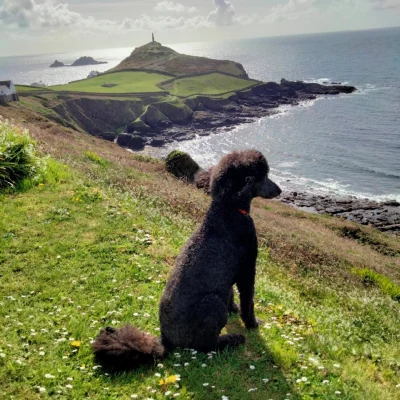
Wheal Call is not suitable for all dogs. The garden is not enclosed and you do get walkers and horse-riders on the coast path above. In the summer months most beaches do not allow dogs between 10am and 6pm and you cannot leave your dog alone in the cottage.
However, if you have a beautifully-behaved, clean, flea and tick-treated, mature dog and think they would be suitable for Wheal Call, please get in touch by email to discuss and receive confirmation that your dog can come on holiday with you.
The fee is £60.00 per dog and strict adherence to our Dog Rules is required.
Do remember that most beaches during the summer do not allow dogs between 10am and 6pm and you cannot leave your dog alone in the cottage.
Here is some useful information for having a successful holiday with your dog in Cornwall

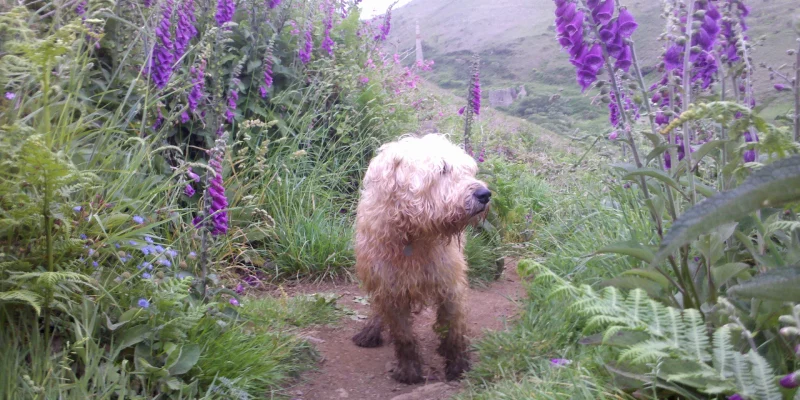
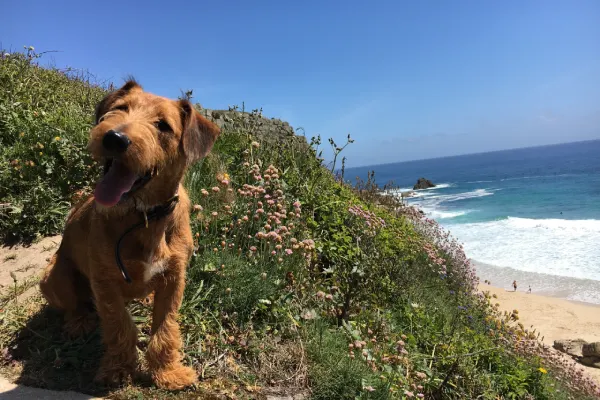
Dog Rules
Firstly, please read and accept these our dog rules for Wheal Call.
Wheal Call Dog Rules
- An increased Security Deposit of £300.00 is required to be paid by bacs transfer before your arrival and returned following your stay.
- All dog mess must be bagged up and taken to the Dog Waste bins in the NT car park, not flicked into the undergrowth by the cottage.
- Dogs must not be left unattended in the cottage at any time.
- Dogs must be walked before arrival to avoid accidents when they first enter!
- Muddy dogs must be washed off and dried in the courtyard before entering the cottage.
- All dogs must be flea and tick treated before they arrive! This is essential and non-negotiable. We suffered a flea infestation which costs hundreds of pounds and 3 weeks to resolve and meant the loss of bookings and income! Proof of treatment is required (eg: receipt for medication or photo of treatment).
- Dogs must be well-trained (no puppies) and under control at all times. The garden is not secure and members of the public walk past on the track above which is part of the South West Coast Path.
- Dogs are not allowed upstairs or on the sofas! There is a gate at the bottom of the stairs.
Gardens & Heritage Sites nearby that welcome dogs:
PK Porthcurno: Discover global communication history at this interactive museum near Penzance where well-behaved dogs on leads are welcome inside (excluding the WWII bunker).
Tremenheere Sculpture Gardens: Located near Gulval, Penzance, these lush sub-tropical and contemporary art gardens warmly welcome dogs on leads.
Trewidden Gardens: These gardens on the outskirts of Penzance are completely dog-friendly, allowing dogs in both the 15-acre garden and the on-site tearoom. The primary rule is that dogs must be kept on a short lead at all times. You can visit the tearoom with your dog without paying the general garden admission fee.
Trengwainton Gardens: . Dogs on short leads are welcome throughout the 25 acres of the garden, the second-hand shop, and the outdoor seating area of the café
St Michael’s Mount: The mount is not fully dog-friendly. Dogs are banned from the island completely from 1st May to 12th September. From 13th September to 30th April, dogs are allowed only in the harbour and village areas on a short lead. They are never allowed in the castle, gardens, or shops.
Geevor Tin Mine: is very dog-friendly across most of its outdoor surface grounds and historic buildings, provided your dog stays on a lead at all times. You can walk all around the historic industrial buildings, machinery yards, and rugged coastal terrain. Fresh drinking water bowls are provided for dogs at various spots across the property.
Dogs are strictly prohibited from going underground on the mine tours (assistance/guide dogs are the only exception here).
While policies can vary slightly by season for specific indoor areas like the café or shop, official site guidelines state that assistance dogs are welcomed everywhere without exception, whereas pet dogs may be restricted from certain enclosed food and retail spaces.
Cornish Council Beach Restrictions for Dogs
Cornwall Council enforces seasonal dog bans on 46 beaches, restricting dogs from 10:00am to 6:00pm.
Standard beaches ban dogs from 1st July to 31st August, while Blue Flag and Seaside Award beaches extend the ban from 15th May 15 to 30th September. Breaching these rules risks a £100 fine.
But there is good news!
Here is a list of West Penwith beaches that allow dogs:
- Bamaluz Beach – TR26 1PR
The remains of Wheal Dream tin mine overlook this quiet, sandy beach. - Cot Valley – TR19 7NT
Two small beaches lie close to the end of the pretty Cot Valley and dogs are allowed on both. - Eastern Green Beach – TR18 3DU
Penzance’s east beach starts at Station Rocks and follows the curve of Mount’s Bay to Longrock. - Gurnards Head (Treen Cove) – TR26 3DE
Treen Cove is a short distance east of the headland and is overlooked by the crumbling Chapel Jane. - Gwenver Beach – TR19 6JB
Gwenver’s name is derived from Gwynevere of Authurian legend. Situated at the base of a grassy cliff, this beach is just about secluded and in-accessible enough to not get really crowded. - Keneggy Sands Beach – TR20 9AU
A secluded, sandy beach with difficult access. A reasonable sized beach at low-tide but it all but disappears on higher tides. - Lambeth Walk Beach – St Ives
This beach is easily overlooked, despite being almost in the town centre of St Ives. Partly because it doesn’t really exist at high tide. Located on the other side of the south pier, between the harbour and Porthminster beach, Lambeth Walk is the only dog friendly beach in St Ives without restriction. - Longrock Beach
Safe family beach with pebbles and sand. A favourite of Penzance locals as it is the most easily accessible stretch of sandy beach from town. - Nanjizel Beach – TR19 7AA
Due to it’s relative inaccessibility, Nanjizel has remained more or less untouched and never gets busy. - Newlyn Beach
This small beach on the edge of Newlyn is located just past the fish market and quay. - Pedn Vounder Beach – TR19 6LF
Often referred to as one of Cornwall’s best beaches with stunning cliffs of Treryn Dinas, a beautiful sandy beach and crystal clear water. - Penberth Cove – TR19 6HJ
Primarily a tiny fishing hamlet. There is a pebble beach. A river flows down through the wooded Penberth Valley into the cove. - Pisky Cove – TR20 9BA
A tiny isolated cove but with no beach at high tide. Known as one of the places in which John Carter (“King of Prussia”) used to land his smuggled goods. - Portheras Cove – TR19 7TU
Situated on one of the wildest stretches of Cornish coast between Pendeen and Morvah this lovely sandy cove is quite tricky to find.
Porthmeor Cove – TR20 8YX
A secluded cove between Land’s End and St Ives. This quiet beach is not be confused with its namesake (Porthmeor beach) in St Ives. - Prussia Cove – TR20 9BA
Small and secluded rocky coves with no beach at high tide. Famed as the home of the Carters, a family of 18th century smugglers (one of whom was known as the King of Prussia.) - Wherrytown Beach
A Large pebble beach situated between Penzance and Newlyn.

If you require information about beaches further afield in Cornwall, you can review the full interactive map and guidelines on the Cornwall Council Dogs on Beaches Guide.
Here is an example of their interactive map showing the restricted area at Porthcurno beach.
Should I wash my dog after being in the sea?


Yes, you should wash your dog after they go in the sea.
You need a fresh-water rinse to remove salt, sand, and germs, but you do not need soap or shampoo every single time. We have an outside tap in the courtyard at Wheal Call for you to use. Don’t forget to brings lots of dog towels!
Why You Should Clean Your Dog
- Stops Itchy Skin:
Salt and sand dry out the skin and cause pain. - Clears Hidden Sand:
Sand gets stuck in paws, bellies, and skin folds. - Removes Germs:
Ocean water can carry bad bacteria or tiny bugs.
Simple Steps to Clean Your Dog
- Rinse Well:
Use clean, lukewarm tap water over their whole body. - Check Paws:
Clean well between their toes and paw pads. - Wipe Ears:
Gently dry their outer ears with a soft towel. - Dry Completely:
Dry their fur all the way so they do not get skin infections. - Use Shampoo Sparingly:
Only use dog shampoo if they are very muddy or smell bad.
Tips on dog-friendly walking in adder habitats
Adders are the UK’s only venomous snake and are commonly found across Cornwall, especially in habitats such as heathland, moorland, rough grassland, woodland edges, and coastal paths including sand dunes.
They are small, grey or brown snakes with a distinctive dark zig‑zag pattern down the back and a V‑shaped marking on the head. Although shy and generally avoiding disturbance, they can bite if accidentally stepped on or surprised — something that happens more often in summer when both adders and dogs are active.
Identification
A male adder tends to have very dark zigzag markings and dark borders to the scales on his snout. His tail is also longer than that of a female, tapering more gradually towards the tip.


A female adder usually has a brown zigzag marking (unlike males, who usually have a very dark, almost black zigzag) and her overall colour tends to be browner than the male. The scales on her snout are also less likely to have dark borders than those of male adders. The tail of the female (beyond the vent/cloaca) is shorter than that of a male and tapers more steeply towards the tip.


Newborn adders are often a beautiful brick-red colour. Until they are mature adults, it can be difficult to tell the sex of adders from their colour or markings.
The photos have been supplied by Amphibian and Reptile Conservation, a national wildlife charity committed to conserving the UK’s amphibians and reptiles and saving the disappearing habitats on which they depend.
Tips
Dog‑friendly walking in adder habitats is absolutely doable in Cornwall — you just need calm, practical habits that reduce the chance of a close encounter.
The single most important principle is keeping your dog close and predictable. In heathland, dunes, moorland, cliff‑top grass, and woodland edges, keep your dog on a short lead or walking to heel.
Adders bask in warm patches of ground, especially early afternoon, so avoid letting your dog roam through long grass, bracken, or gorse where visibility is low. Staying on clear, well‑trodden paths dramatically reduces risk.
- Stay on clear paths — reduces the chance of stepping on a basking snake.
- Use a short lead — keeps your dog close and prevents sudden darting into vegetation.
- Avoid dense vegetation such as long grass, gorse, bracken and tussocky grass — prime basking spots for adders.
- Pause before stepping over obstacles — snakes often shelter under warm objects.
- Pause at obstacles – snakes often shelter under warm objects.
- Watch for signs of heat‑basking — sunny patches on paths or dunes.
- Walk earlier or later – adders are most actve in midday heat.
- Know emergency steps — calm, carry, call the vet.

What to do if my dog is bitten by an adder
- If your dog is bitten by an adder, treat it as an emergency.
- Keep your dog as calm and still as possible to slow the spread of venom, carry them if you can, and call your vet immediately.
- Do not apply a tourniquet, squeeze the wound, or attempt to suck out venom — these actions can worsen the injury.
- If safe, bathe the bite gently with cool water while you travel.
- Symptoms can range from local swelling and pain to vomiting, weakness, breathing difficulties, or collapse, and rapid veterinary treatment greatly improves recovery chances.
- Adders are protected by law, so never attempt to harm the snake
There are a few vets in Penzance, please see their contact details below:
Regent Court Vets
Lower Queen Street
Penzance
TR18 4DE
Tel: 01736 368768
Email: reception@regentcourtvets.co.uk
To open their website on a new tab, click on their logo below:
Rosevean Veterinary Practice
Coombe Rd
Penzance
TR18 3HU
Tel: 01736 362215
Out of Hours: 01736 362215

